Evaluating Revolver Gun: A Display Typeface with Western Flair
In the search for typefaces that carry distinct personality without sacrificing clarity, designers often encounter fonts that prioritize style over substance. Revolver Gun presents itself as a display font with a clear Western and vintage aesthetic. It is not designed for body text or lengthy paragraphs, but rather for moments where typography needs to make an immediate visual statement. Understanding its intended use, strengths, and limitations is key to determining if it aligns with your project's goals.
Character and Design Intent
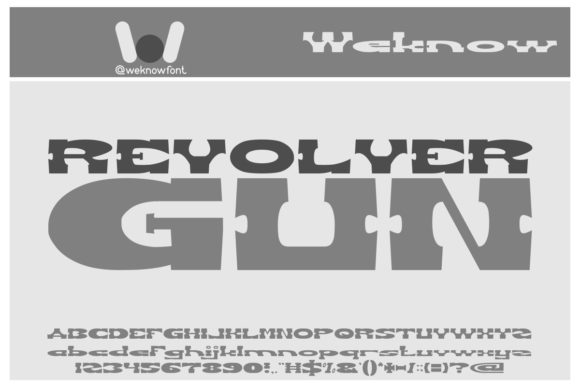
At its core, Revolver Gun is a typeface built for impact. Its design references the bold, condensed lettering often associated with wanted posters, classic Western films, and vintage signage. The characters typically feature strong vertical stress, noticeable contrast between thick and thin strokes, and sometimes subtle decorative details like spurs or sharp terminals. This gives it an unmistakable sense of place and era. The font's purpose is to evoke a specific mood—rugged, adventurous, or nostalgic—rather than to serve as a neutral typographic workhorse.
The strength of Revolver Gun lies in its ability to instantly set a tone. For a logo, a headline, or a title card, it communicates character before a single word is read. This can be a powerful tool for branding or thematic design, where the visual language of the typeface supports the core message. It functions effectively as a headline font or for short, punchy phrases where its stylistic details can be fully appreciated without causing readability issues.
Practical Applications and Project Suitability
Where does a font like Revolver Gun find its most effective application? Its utility is highest in projects where the Western or vintage aesthetic is not just decoration but a fundamental part of the concept. Consider these scenarios:
- Brand Identity and Logos: For businesses like craft distilleries, rustic cafes, adventure travel companies, or heritage brands, a logo set in Revolver Gun can convey authenticity and a sense of story. It works well for apparel brands aiming for a rugged, Americana feel.
- Editorial and Entertainment: It is well-suited for titles on movie posters, book covers (especially in genres like Westerns, historical fiction, or adventure), music album art, and magazine feature headers. Its use in game interfaces or title screens for themed video games is a natural fit.
- Digital and Social Media: YouTube thumbnails, Instagram story graphics, or website hero sections that require a strong, thematic hook can benefit from its assertive presence. It can make a digital asset feel more curated and intentional when the theme is right.
- Event and Environmental Design: For themed events, festival posters, or signage for establishments with a specific ambiance, this font can contribute significantly to the overall environment and guest experience.
It is less suitable, however, for corporate reports, academic materials, user interface elements, or any context demanding neutral professionalism and extended readability. Its personality is a feature in one context and a liability in another.
Usability and Consistency Considerations
A practical evaluation of any display font must consider its technical execution. How well does Revolver Gun perform in terms of letter spacing, kerning pairs, and consistency across different sizes? A well-crafted display font will maintain its visual integrity when scaled, with careful attention to the optical spacing between characters. Poor kerning can undermine even the best design, leading to awkward gaps or collisions between letters like 'A' and 'V' or 'T' and 'o'.
Furthermore, the character set matters. Does Revolver Gun include a full range of punctuation, numerals, and common accented characters? For projects targeting an international audience, comprehensive language support is not a luxury but a necessity. A font that looks perfect in English headlines but lacks the characters for other languages limits its practical value. Checking the font specimen sheet for these details before committing to a project is a professional imperative.
Balancing Style with Function
The primary limitation of a font like Revolver Gun is also its defining feature: its strong stylistic identity. This creates a narrow band of optimal use. Overuse can lead to visual monotony or make a design feel like a theme park rather than a serious project. The key is strategic deployment. Pairing it with a highly legible, neutral sans-serif or serif font for supporting text creates necessary contrast and ensures the overall design remains functional.
Think of Revolver Gun as a specialty tool in a designer's toolkit. You wouldn't use a decorative chisel for every woodworking task, but for specific joinery or detailing, it's irreplaceable. Similarly, this font is not for every project, but for the right one, it provides a level of thematic coherence that generic fonts cannot match. Its long-term value is tied to the relevance of its aesthetic; if Western or vintage styles are core to your brand's identity, it remains a valuable asset.
Making an Informed Decision
Before integrating Revolver Gun into your workflow, conduct a small-scale test. Mock up your intended use—a logo lockup, a poster headline, a website banner. Evaluate it in context. Does it enhance the message or distract from it? Does it feel authentic or forced? Seek feedback from colleagues or your target audience if possible.
For designers, marketers, and creators working within specific thematic niches, Revolver Gun offers a genuine stylistic shortcut. It can elevate a project by providing a built-in sense of character and history. However, its effectiveness is contingent on a clear understanding of its purpose and the discipline to use it appropriately. When matched with the right project, it moves beyond being a mere font choice to become a fundamental component of the visual storytelling. Its practical value, therefore, is not universal, but for those it serves, it can be quite significant.